Indian passport holders can obtain a 5-year multiple-entry tourist visa for Japan (valid for stays up to 90 days per visit) through five official MOFA routes—and first-time visitors can qualify under Route 4 based on "sufficient financial capacity" using their latest Income Tax Return (ITR) alone without prior international travel history. The statutory consular visa fee is exactly ₹500 (the same fee as a single-entry visa), accompanied by a VFS Global service charge of ₹800.
(All visa procedures, statutory fees, and document requirements cited in this guide reflect the official 2026 Embassy of Japan in India and Ministry of Foreign Affairs (MOFA) regulations. Consular authorities always evaluate applications on a case-by-case basis.)
For frequent travelers, business executives, and solo explorers, holding a multiple-entry visa eliminates the repetitive cycle of gathering notarized forms, visiting VFS Global intake centers, and paying recurring agency fees for every vacation. Yet online travel forums and commercial visa agencies routinely spread two major misconceptions: that first-time visitors to Japan are strictly ineligible, and that multiple-entry applications demand three consecutive years of exorbitant tax filings or locked fixed deposits.
Under official Japanese immigration policy, neither claim is true. This guide details MOFA's five statutory eligibility routes, specifies the exact paperwork needed for each category, explains how to align your application form and covering letter, and shows you how to protect your application from being downgraded to single-entry.
The 5 Official MOFA Routes to a Japan Multiple-Entry Visa
The Ministry of Foreign Affairs of Japan (MOFA) outlines five distinct eligibility categories for Indian nationals applying for a temporary visitor multiple-entry visa for tourism, commerce, or visiting relatives (documented in MOFA's Application Procedures for Multiple Visa for Nationals of India). Each route has different evidentiary thresholds:
Route # | Eligibility Criteria | Primary Document Required | Who Should Apply |
|---|---|---|---|
Route 1 | Two or more visits to Japan as a temporary visitor within the last 3 years | Old/current passports showing previous Japanese entry and departure stamps | Returning travelers who already hold physical proof of two recent Japan trips |
Route 2 | One visit to Japan within the last 3 years PLUS sufficient financial capacity | Previous Japan visa/stamps + latest Indian Income Tax Return (ITR-V) | Travelers who visited Japan once recently and earn steady taxable income |
Route 3 | One visit to Japan within the last 3 years PLUS visits to G7 nations | Passports showing past Japan visit + valid visas/entry stamps from G7 countries | Globetrotters who have visited Japan plus the US, UK, Canada, Schengen, or others |
Route 4 | Sufficient financial capacity alone (No prior Japan travel required) | Latest Indian Income Tax Return (ITR-V / Acknowledgement) | First-time visitors, salaried professionals, business owners, and freelancers |
Route 5 | Immediate family member (spouse or child) of an eligible Route 4 applicant | Proof of relationship (marriage or birth certificate) + primary applicant's ITR | Dependents traveling together or joining an eligible Route 4 applicant |
Tip: If you have never traveled to Japan before, Route 4 is your default gateway. You do not need an invitation letter from Japan, a sponsor, or prior international stamps to qualify under this category.
Document Checklist: Exactly What Each Route Requires
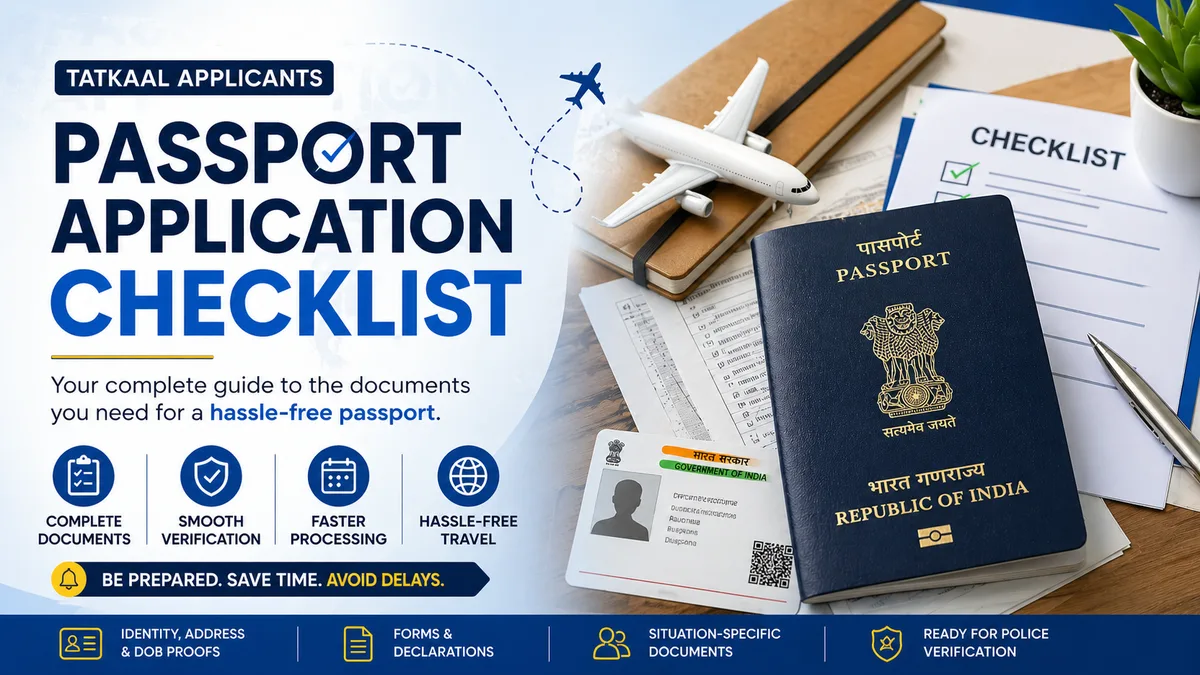
Every multiple-entry visa application starts with the foundational single-entry dossier: your valid Indian passport (with at least two blank pages), two copies of the passport bio-data pages, the completed Japan visa application form, and one recent 45 mm × 35 mm photograph taken against a plain white background.
Beyond the universal identity documents, VFS Global centers across India require route-specific supporting evidence (codified in VFS Delhi checklists MULTIPLE-1 through MULTIPLE-4):
Route 1: Two Prior Japan Visits in 3 Years
If you have entered and exited Japan at least twice within the past 36 months under Temporary Visitor status, your travel track record serves as your financial guarantee.
Current and previous passports: Original physical booklets showing both sets of Japanese temporary visitor visas, entry stamps, and port-of-entry stickers.
Passport copies: Clear photocopies of the specific passport pages bearing the Japanese entry/exit stamps.
Income documents: Not mandatory under Route 1. MOFA does not require an ITR or bank balance certificate for this category, though submitting your recent bank statement remains good practice.
Covering letter: Brief explanation noting your previous entry dates and expressing your intent to revisit Japan on multiple occasions.
Route 2: One Prior Japan Visit + Financial Capacity
If you have visited Japan once within the last 3 years, you can secure a 5-year multiple-entry visa by coupling that visit with proof of steady domestic income.
Proof of prior visit: Original passport containing your previous Japanese visa sticker and immigration entry/departure stamps.
Latest Income Tax Return (ITR-V): Official acknowledgement from the Indian Income Tax Department for the most recent assessment year.
Bank statements: Last 6 months of original personal bank statements stamped by your issuing bank, demonstrating active transactions and a healthy operating balance.
Employment verification: A company leave approval letter or certificate of employment confirming your job designation and tenure.
Route 3: Prior Japan Visit + G7 Country Travel
For well-traveled applicants, entry into member nations of the Group of Seven (G7)—the United States, Canada, the United Kingdom, France, Germany, Italy, or Japan—demonstrates established immigration compliance.
Proof of prior Japan visit: Passport showing at least one Japan entry and departure stamp within the last 3 years.
Proof of G7 travel: Original passports and clean photocopies showing valid visas and stamped entries/exits into any G7 country (e.g., US B1/B2, UK Standard Visitor, Canadian Tourist, or Schengen visas issued by France, Germany, or Italy) within the last 3 years.
Financial documents: Explicitly exempted from mandatory submission under MOFA's Route 3 guidelines, though maintaining active bank statements in your file is strongly advisable.
Route 4: First-Timers with Financial Capacity Alone
Route 4 is the most important pathway for the vast majority of Indian applicants. You do not need any previous travel history to East Asia or the West.
Latest Income Tax Return: Official ITR-V acknowledgement slip for the most recent financial year. Note that MOFA's statutory instructions specify the latest tax return—you are not legally required to submit three consecutive years of filings, though providing the last two years adds helpful depth if your income grew significantly.
Bank statements: Original 6-month bank statements with genuine bank seal and signature. While MOFA prescribes no statutory minimum balance, maintaining a consistent balance of ₹2.5–4 Lakhs (or above) per traveling adult provides clear proof that you can fund recurring trips without domestic distress.
Supplementary asset documentation (Optional): If your ITR shows variable income (e.g., consultants, freelancers, or business proprietors), you may attach bank fixed deposit certificates, mutual fund holding statements, property deeds, or stock dividend summaries.
Covering letter with multi-trip intent: An explicit personal statement explaining why your professional commitments, personal passions, or seasonal travel plans necessitate multiple visits across Japan.
Route 5: Dependents of a Route 4 Applicant
If an applicant qualifies under Route 4, their legally recognized spouse and dependent children under 20 years of age qualify automatically under Route 5.
Proof of relationship: Government-issued marriage certificate (for spouse) and original birth certificate (for dependent children).
Primary applicant's financial dossier: Copies of the primary earner's latest ITR-V, bank statements, and employment letter.
Primary applicant's visa copy: If the primary applicant already holds an active Japan multiple-entry visa, provide a clear color photocopy of their visa sticker alongside their passport bio page.
What Documents Are NOT Required for Multiple-Entry?
Commercial visa agencies frequently confuse single-entry requirements with multiple-entry guidelines. Knowing what the Embassy does not ask for saves you hours of wasted paperwork:
No Schedule of Stay for future trips: You are only required to detail your first upcoming visit on your application form and covering letter. You do not need to submit speculative day-by-day itineraries for hypothetical vacations two or four years away.
No confirmed round-trip flight tickets: Neither MOFA nor VFS mandates non-refundable, fully paid flight tickets before visa approval. Verifiable airline reservation itineraries showing flight numbers and prospective dates are completely sufficient.
No hotel bookings for subsequent journeys: You only need an initial accommodation reservation for the first city of your first trip.
No invitation letter or Japanese guarantor: For regular independent tourism under Routes 1 through 4, no guarantor, sponsor, or letter of invitation from Japan is required. (Letters of guarantee are strictly reserved for visiting acquaintances, relatives, or business partners per our Japan visa invitation letter guide).
How to Structure Your Covering Letter for Multiple Entry
While MOFA officially relaxed the mandatory "Explanation Letter" requirement for multiple-entry tourist visas under press release 4e_001792, VFS Global checklists across New Delhi, Mumbai, and Bengaluru still include the line item: "Covering letter (if any special explanation is needed)."
For first-time Route 4 applicants, submitting a tailored covering letter is essential. When a consular officer reviews your file, this letter provides the exact rationale for why your request should be approved as multiple-entry rather than downgraded to single-entry.
Use the structured format below, editing the bracketed fields to match your personal circumstances:
[Date]

To,
The Visa Officer,
Embassy of Japan / Consulate-General of Japan,
[City - New Delhi / Mumbai / Bengaluru / Chennai / Kolkata]

Subject: Application for 5-Year Multiple-Entry Temporary Visitor Visa (Tourism) — [Your Full Name], Passport No: [Your Passport Number]

Respected Consular Officer,

I am submitting my application for a 5-Year Multiple-Entry Tourist Visa (Temporary Visitor) to Japan under MOFA Eligibility Route 4 (Sufficient Financial Capacity).

I am currently employed as [Your Designation] at [Company Name], earning an annual taxable income of INR [Your Annual Income as per ITR]. Enclosed with this application is my official Income Tax Return Acknowledgement (ITR-V) for the latest Assessment Year [e.g., 2025–2026], alongside my verified 6-month bank statements reflecting a closing balance of INR [Your Balance].

PURPOSE AND PROPOSED INITIAL TRIP:
I have scheduled my first visit to Japan from [Date of Arrival] to [Date of Departure] (total [X] days). During this trip, I intend to explore Tokyo, Kyoto, and Osaka. My accommodation has been arranged at [Hotel Name], Tokyo, and I have prepared a comprehensive itinerary for this initial stay.

RATIONALE FOR MULTIPLE-ENTRY REQUEST:
Japan offers an extraordinary breadth of seasonal culture, culinary heritage, and diverse regional landscapes that cannot be experienced in a single visit. Over the next five years, I plan to undertake multiple short-duration vacations during official work leave windows, including:
1. Autumn Foliage Tour (November): Visiting the Kansai and Chubu regions (Kyoto, Kanazawa, and Takayama).
2. Winter Snow Festival (February): Visiting Hokkaido (Sapporo and Otaru).
3. Cherry Blossom Season (April): Visiting the Fuji Five Lakes and Tohoku region.

Having a multiple-entry visa will enable me to plan these regional trips spontaneously around my corporate commitments without repeating the administrative application cycle for each brief journey.

I confirm that I will abide by all Japanese immigration laws, fund all travel expenses from my personal earnings, never seek local employment, and depart Japan prior to the expiration of my permitted duration of stay on every visit.

Thank you for your consideration.

Yours sincerely,

[Your Signature]
[Your Full Name]
[Phone Number]
[Email Address]
Tip: Pair your covering letter with a realistic initial travel route—such as a curated 10-day Japan itinerary that connects Tokyo, Hakone, Kyoto, and Osaka—so consular staff can verify your entry logistics immediately.
Aligning Your Visa Application Form with Multiple Entry
When filling out the official two-page visa application form (refer to our step-by-step walkthrough on how to fill the Japan visa application form), make sure your form responses align with your multiple-entry request:
Intended length of stay: For the duration box on page one, write the length of your first upcoming trip (e.g.,
10 Daysor14 Days), not "5 Years". The validity of the visa (5 years) and the duration of each individual stay (up to 90 days) are separate legal determinations made by the consular officer.Port of entry & Airline: Enter the specific international airport where you plan to land on trip one (e.g.,
Narita (NRT)orHaneda (HND)) and your intended carrier (e.g.,Air IndiaorANA).First accommodation details: Provide the complete name, address, and telephone number of your booked hotel or hostel for night one.
Guarantor and Inviter sections (Page 2): For independent tourist applications under Routes 1 through 4, write
N/Ain all guarantor and inviter boxes. Do not leave them blank.
Fees, Processing Timelines, and Submission Channels
Expense / Parameter | Official Rate / Timeline | Payment & Collection Method |
|---|---|---|
Consular Visa Fee | ₹500 (Statutory fee for Single or Multiple entry) | Paid at VFS intake counter; exact cash, debit, or UPI |
VFS Service Fee | ₹800 (Standard logistics processing charge) | Mandatory service fee levied per applicant dossier |
Optional Courier Fee | ₹550 (Passport return to your home address) | Optional service; trackable secure courier delivery |
Standard Processing Time | Minimum 5 to 7 working days | Working days exclude weekends and diplomatic holidays |
Submission Channel | VFS Global in-person appointment | In-person document submission or via an authorized representative |
The Statutory Fee Parity: Why Multiple Entry Costs Only ₹500
A common concern among first-time applicants is that a 5-year multiple-entry visa must be vastly more expensive than a single-entry pass. In reality, the Embassy of Japan maintains statutory fee parity: both single-entry and multiple-entry tourist visas carry an official consular fee of exactly ₹500 for Indian nationals.
Even with the mandatory VFS service fee (₹800) and optional courier delivery (₹550), your total government and processing outlay comes to roughly ₹1,850.
Why You Cannot Use Japan eVISA for Multiple Entry
The online Japan eVISA portal (launched for Indian passport holders residing in India through accredited travel agencies) is strictly restricted to single-entry temporary visitor visas.
If you want a multiple-entry visa, you must submit a physical paper application through your regional VFS Global Application Centre. Any online eVISA submission will only result in a standard single-entry electronic permit.
What Happens If Your Visa Is Downgraded to Single Entry?
Every official VFS multiple-entry checklist carries a standard statutory disclaimer: "Please note that the Embassy may issue a single entry visa after the assessment of the application."
If consular authorities determine that your travel history is too nascent or your verifiable liquid savings do not comfortably support recurrent international journeys, they will frequently issue a standard 30-day or 90-day single-entry tourist visa instead of issuing an outright rejection.
If your visa is downgraded:
It is NOT a visa refusal: A downgrade does not represent a rejection mark on your immigration history. You are fully authorized to execute your planned initial holiday to Japan.
The 6-month reapplication bar does NOT apply: Unlike a formal visa rejection (which triggers a mandatory 6-month statutory waiting period per our analysis of Japan visa rejection reasons), a downgrade allows you to travel freely. Once you return from your initial vacation with physical entry and exit stamps, you become immediately eligible to apply under Route 2 on your subsequent journey.
Frequently Asked Questions
Can a first-time traveler from India get a Japan multiple-entry visa?
Yes. Under official MOFA Route 4, any Indian passport holder demonstrating sufficient financial capacity through their latest Income Tax Return (ITR-V) can qualify for a 5-year multiple-entry tourist visa without prior international travel stamps.
What is considered "sufficient financial capacity" by the Embassy of Japan?
MOFA specifies document types (latest ITR-V, stamped bank statements, fixed deposits) rather than a rigid statutory income cutoff. As a practical benchmark, applicants reporting an annual taxable income of ₹7–10 Lakhs or above on their ITR and maintaining healthy liquid balances of ₹2.5–4 Lakhs routinely secure multiple-entry approvals.
How many years of Income Tax Returns (ITR) must I submit?
MOFA and VFS guidelines officially require only your latest Income Tax Return (ITR-V acknowledgement). While commercial travel agents often demand three years of filings, submitting your single most recent assessment year satisfies statutory checklist criteria. If your income has grown significantly, submitting the last two years provides helpful context.
What is the maximum duration of stay permitted on each visit?
A standard tourist multiple-entry visa is valid for up to 5 years, allowing stays of up to 90 days per visit. The 10-year validity visa is strictly reserved for the business and cultural/intellectual track (e.g., corporate executives of listed companies, government officials, accredited academics, and chartered accountants).
Can Indian passport holders living in Singapore or Dubai apply for this visa?
Yes, but you must submit your application to the Embassy or Consulate-General of Japan accredited to your country of legal residence (e.g., the Embassy of Japan in Singapore or the Consulate-General of Japan in Dubai). You will be required to provide your local employment pass or permanent residency documentation alongside your financial records.
Do I need to book my second or third trip before applying?
No. You only need to plan and document your first proposed entry into Japan. Your covering letter should articulate realistic seasonal themes for future vacations, but no bookings or tickets are required beyond your initial trip.
Next Steps for Your Japan Journey
Securing a 5-year multiple-entry visa unlocks effortless travel across Japan, allowing you to experience the country across different seasons—from neon-lit Tokyo nights to cherry blossom blooms in Kansai and winter powder in Hokkaido.
To ensure your visa file is flawless from day one:
Review our foundational Japan visa documents checklist to assemble your bank records and identity proofs.
Follow our step-by-step guide to filling the Japan visa application form to prevent clerical discrepancies.
Review our verified Japan visa cover letter sample to tailor your personal statement.
Use our Japan travel itinerary planner to build your custom Japan travel itinerary and generate an official day-by-day route you can confidently submit with your visa dossier.