Yes — a vegetarian Indian family can eat well in both Kyoto and Osaka, but the two cities work in completely different ways. Kyoto is the easy one: it has Japan's own 800-year-old Buddhist vegetarian tradition (shōjin ryōri) plus a dense cluster of small vegan cafés you can walk to between temples. Osaka is the harder one: it's a street-food city built on octopus, pork and fish flakes, so you eat at a handful of specific addresses rather than wandering. This guide gives you those addresses, area by area, plus what the kids will actually eat on the days everything goes sideways.
First, the rule that catches every family: dashi
Everything below assumes you already know the one trap. Dashi — the stock made from kelp and dried skipjack tuna (katsuobushi) — is the base of most miso soups, noodle broths, simmered vegetables and dipping sauces in Japan. A bowl of "vegetable udon" is almost always sitting in fish broth. So a menu saying "vegetarian" doesn't mean what it means at home, and with kids in tow you don't want to be litigating ingredient lists three times a day.
Our vegetarian food in Japan survival guide has the ready-to-show Japanese translation card for exactly this — keep it saved on your phone. This post is the Kansai companion to it, and to the Tokyo vegetarian food guide if Tokyo is the first stop on your route.
Tip: With children, plan one guaranteed meal a day at a fully veg or vegan place, and treat everything else as a bonus. That single booking removes about 80% of the daily food stress.
Vegetarian food in Kyoto, area by area
Kyoto is compact and you'll move between four or five zones. Here's a reliable option in each.
Kyoto Station — your arrival-day safety net
You'll land here off the Shinkansen with tired kids, and this is where families panic. VEGE DELI Kanna, inside the station's food-court area, is one of the few genuinely vegan counters in a Japanese food court — plates start around ¥500 (roughly ₹280; approximate, varies), it's fast, and nobody has to sit through a two-hour meal. Miyakoyasai Kamo Kyoto-ekimae, just outside the station, is a Kyoto-vegetable restaurant with clearly marked vegetarian and vegan dishes and a lunch spread around ¥1,000 (about ₹550) — the better pick if you want everyone to actually sit down.
Downtown — Nishiki Market, Teramachi and Kawaramachi
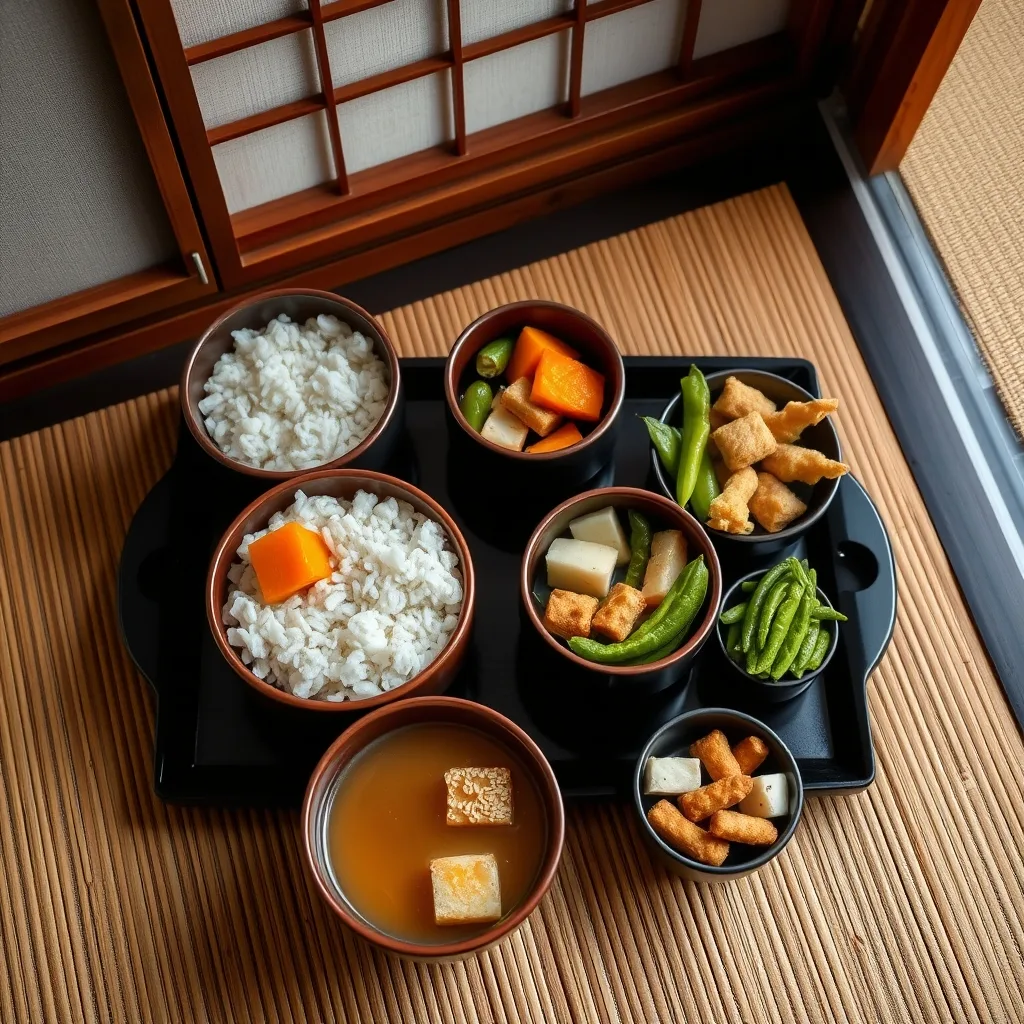
This is your densest cluster. Mumokuteki Cafe & Foods sits on an upper floor of a vintage store a few minutes from Nishiki Market — an all-vegetarian café doing Japanese-style gozen set meals (rice, soup, several small dishes), which is the single most kid-legible format in Japan: everything is visible, nothing is a mystery broth. It's closed Wednesdays. A short walk away, Vegan Ramen UZU Kyoto does an all-vegan ramen with a broth built over 12 hours from kelp, shiitake and vegetables, in a dark room with teamLab artwork projected across the table — a genuine "meal as an outing" for older kids. It's small, opening days are limited, and it books out; reserve well ahead rather than turning up.
About Nishiki Market itself: it's wonderful to walk, but treat it as sightseeing, not lunch. Most stalls are seafood, and even the innocent-looking pickles and simmered vegetables are frequently made with bonito. Graze on the safe things — soy-milk doughnuts, roasted chestnuts, fruit, yuba (tofu skin) — and eat a real meal on either side of it.
Gion and Higashiyama
Temple-hopping days end hungry. Gion Soy Milk Ramen Uno Yokiko does a vegan soy-milk ramen (gluten-free options too) and is open right through the afternoon, which matters when a family eats at 3 pm because the morning ran long. Near Yasaka Shrine, Tokkyu Ramen keeps one vegan sesame-miso ramen on the menu at around ¥950 (about ₹520; approximate, varies) — cheap, quick, and closed Wednesdays.
Arashiyama — eat shōjin ryōri once
Do this once as the trip's one splurge meal. Shigetsu, inside the grounds of Tenryū-ji temple in Arashiyama, serves Zen Buddhist temple cuisine that is entirely plant-based by doctrine — no meat, no fish, no dashi, nothing to check. Lunch sets start around ¥3,800 per person (roughly ₹2,100; approximate, varies, and you also pay the temple garden entry), it's lunch-only and closed Thursdays, and you must reserve. For an Indian vegetarian family this is a rare thing: a formal, high-end Japanese meal where you are the default customer rather than the exception. Slot it into the Arashiyama half of your route — our 3-day Kyoto itinerary lines up the temple order so the booking time actually fits.
Vegetarian food in Osaka, area by area
Osaka's food identity is kuidaore — eat till you drop — and almost all of it is octopus, pork or fish flakes. The good news: the city's vegan restaurants are excellent and they cluster exactly where you'll be staying.
Namba, Dotonbori and Shinsaibashi
Paprika Shokudo Vegan near Shinsaibashi is the anchor address — fully vegan, mains from about ¥800 (roughly ₹440; approximate, varies), with rice bowls, pasta, pizza and soy-meat dishes that cover both the adventurous and the fussy eater at the same table. Its second branch in Shinsekai (under the Tsūtenkaku tower) runs as a vegan izakaya doing kushikatsu — the fried skewers Shinsekai is famous for — at roughly ¥140–370 a skewer, plus vegan, gluten-free takoyaki around ¥740. That's the closest a vegetarian family gets to the real Osaka street-food experience.
In Dotonbori, OKO Okonomiyaki runs a separate, clearly labelled vegan menu — vegan okonomiyaki, yakisoba and gyoza — cooked on the teppan in front of you, which children reliably find more interesting than the food itself. It's evening-only, tiny, and closes when it sells out, so go early. Nearby, Gyozaoh Dotonbori does vegetable gyoza from around ¥480.
Honmachi and Umeda
Green Earth, about five minutes from Hommachi Station, is Osaka's veteran — open since 1991, fully vegan since 2019, with an English menu, English-speaking staff and a daily lunch set around ¥1,100 and curry around ¥950 (roughly ₹600 and ₹520; approximate, varies). Unfussy, cheap and calm: the sort of place you go back to twice. Over in Tennoji, Okonomiyaki Chitose does a vegetarian okonomiyaki with soy meat at about ¥1,200 (₹660).
Tip: Osaka's dedicated veg places are small and many are cash-only. Carry ¥10,000–15,000 in cash for food days and withdraw from a 7-Bank ATM inside any 7-Eleven — they take Indian cards and have an English menu.
Can vegetarians eat takoyaki and okonomiyaki?
Straight answer: not the standard versions. Takoyaki is built on octopus, and both takoyaki and okonomiyaki are made with dashi in the batter and topped with dancing bonito flakes — so "no meat, please" gets you a dish that's still not vegetarian. Kuromon Ichiba Market, likewise, is largely a seafood market; walk it in the morning for the atmosphere and the cut fruit, then eat elsewhere. The vegan versions at Paprika Shokudo Shinsekai (takoyaki) and OKO (okonomiyaki) are how you tick these off the list honestly, and they're a short walk from the Dotonbori and Shinsekai sightseeing you're doing anyway — see our Osaka itinerary with kids for how those areas fit into a family day.
When everyone just wants Indian food
Day four is usually when a child announces they want dal-chawal. Both cities can deliver.
In Kyoto: Kerala on Kawaramachi has been serving both North and South Indian for decades — around 40 curries, a clearly marked vegetarian section, and a thali lunch set that lands roughly in the ¥1,000–1,500 range (about ₹550–830; approximate, varies). Ashoka, in the Teramachi arcade near Kawaramachi Station, has been running over thirty years and is the easy sit-down dinner option. If you're staying north near Demachiyanagi, DiDi does South Indian dosas, sambar and a five-curry thali set.
In Osaka: Shama in Kitahorie (Yotsubashi Station, exit 6) is fully vegetarian Indian with most dishes available vegan — lunch sets from roughly ¥650 and dinner sets around ¥1,800 (about ₹360 and ₹990; approximate, varies). It's cash-only and its hours move around, so call before you make it the plan. Khazana in Nishinakajima — two minutes from Nishinakajima-Minamigata station, one stop from Umeda on the Midōsuji line — is fully vegetarian and does a proper Gujarati thali, which is the meal most likely to make a homesick family feel human again.
Jain, and no-onion-no-garlic eating
Strict Jain eating is the hardest ask in Japan, and it's better to plan around it than to negotiate at the counter. Japanese kitchens use onion and garlic freely, and root vegetables are everywhere in the simmered dishes that otherwise look safe.
Two things actually work. First, call a pure-veg Indian restaurant ahead and ask for a Jain preparation — Shama in Osaka is listed as able to cook without onion and garlic on request, and Indian restaurants in both cities will usually try if you give them a day's notice. Second, lean on the untouched-ingredient meals: plain steamed rice, fruit, plain inari or salt onigiri from a convenience store, and temple shōjin ryōri, which excludes onion and garlic by Buddhist precept — that last one makes Shigetsu in Kyoto unexpectedly the most Jain-compatible restaurant meal in Kansai. Confirm when you book; recipes vary.
The Kansai konbini and supermarket cheat-sheet
Two or three of your meals a day will come from a convenience store, and in Kansai you have supermarkets as well — cheaper, and better for a family of four.
Salt (shio) onigiri and inari sushi are the safest rice items. Skip the kombu, umeboshi and takana fillings, which routinely contain fish extract.
Edamame, cut fruit, plain salads (dressing on the side), bread, mochi and sweet buns — the standard safe list at 7-Eleven, Lawson and FamilyMart.
Fresco in Kyoto and Life in Osaka are the local supermarket chains: cheaper fruit, bread, curd, and bento-sized boxes of plain rice for picky eaters.
CoCo Ichibanya, the Japanese curry chain, serves a vegetarian curry at branches nationwide (from around ¥841, about ₹460) — with kids, this is the single most useful fallback in Japan, because there's one near almost everything and the spice level is adjustable.
Learn to spot 魚 (fish) and 肉 (meat) on labels, or point Google Lens at the ingredient list — it translates a packet in about two seconds.
Roughly what food costs (₹, per person)
Approximate 2026 ranges at ¥100 ≈ ₹55; prices vary by area, season and booking.
Meal type | Yen | Approx ₹ |
|---|---|---|
Konbini meal (onigiri + sides) | ¥400–700 | ₹220–390 |
Vegan café lunch set | ¥900–1,500 | ₹500–830 |
Indian veg thali | ¥1,000–2,000 | ₹550–1,100 |
Shōjin ryōri temple lunch | ¥3,800–5,000 | ₹2,100–2,750 |
For a family of four, budget roughly ₹5,000–7,000 a day for food across Kyoto and Osaka if you do konbini breakfasts, one café or Indian lunch and one sit-down dinner — with one temple-cuisine meal added as a one-off. That sits inside the food line of our Japan trip cost breakdown from India.
FAQ
Is Kyoto or Osaka easier for vegetarians? Kyoto, clearly. It has the shōjin ryōri tradition, a higher density of dedicated vegan cafés, and tofu and yuba as local specialities rather than afterthoughts. Osaka is very manageable but concentrated — you need the addresses in advance, because wandering into a random Osaka restaurant as a vegetarian usually ends in a plate of edamame.
What are the vegetarian options at Universal Studios Japan? Better than they used to be. USJ introduced an official plant-based menu in late 2023 and expanded it across the park; the items are marked with a green icon on menu boards and on the official site, including at Kinopio Café in Super Nintendo World and Three Broomsticks in the Wizarding World, with vegetable pho and spring rolls at Lost World Restaurant and falafel at Finnegan's. Note that outside food may not be eaten inside the park — if your child has a specific dietary need, ask a crew member at the gate rather than assuming.
Can we eat at Nishiki Market or Kuromon Ichiba? Walk both, eat lightly. Both are seafood-dominant, and bonito turns up in pickles and simmered dishes that look plant-based. Fruit, chestnuts, soy-milk doughnuts and yuba at Nishiki are safe; treat Kuromon as a morning sightseeing stop and plan lunch nearby in Namba.
What will fussy kids actually eat? Plain rice, vegan curry at CoCo Ichibanya, vegetable gyoza, soy-milk ramen, edamame, fruit, bread and mochi — plus konbini onigiri, which most children take to immediately. The gozen set-meal format (many small separate bowls) works far better with children than a single mystery bowl.
Do we need to book vegetarian restaurants in advance? For the small ones, yes. Vegan Ramen UZU and Shigetsu need reservations days to weeks ahead, and OKO in Dotonbori closes when it sells out. Green Earth, Paprika Shokudo, VEGE DELI Kanna and the Indian restaurants are generally walk-in.
Plan your Kyoto and Osaka food days
The families who eat well in Kansai aren't luckier — they just decided their meals before they landed. Pick one guaranteed veg restaurant per day, book Shigetsu and UZU early, and keep a konbini list for the gaps. Then use our planner to build your custom Japan travel itinerary and pin these restaurants to the days you're actually in each neighbourhood, so nobody is standing outside a Dotonbori takoyaki stall at 9 pm negotiating with a hungry seven-year-old.